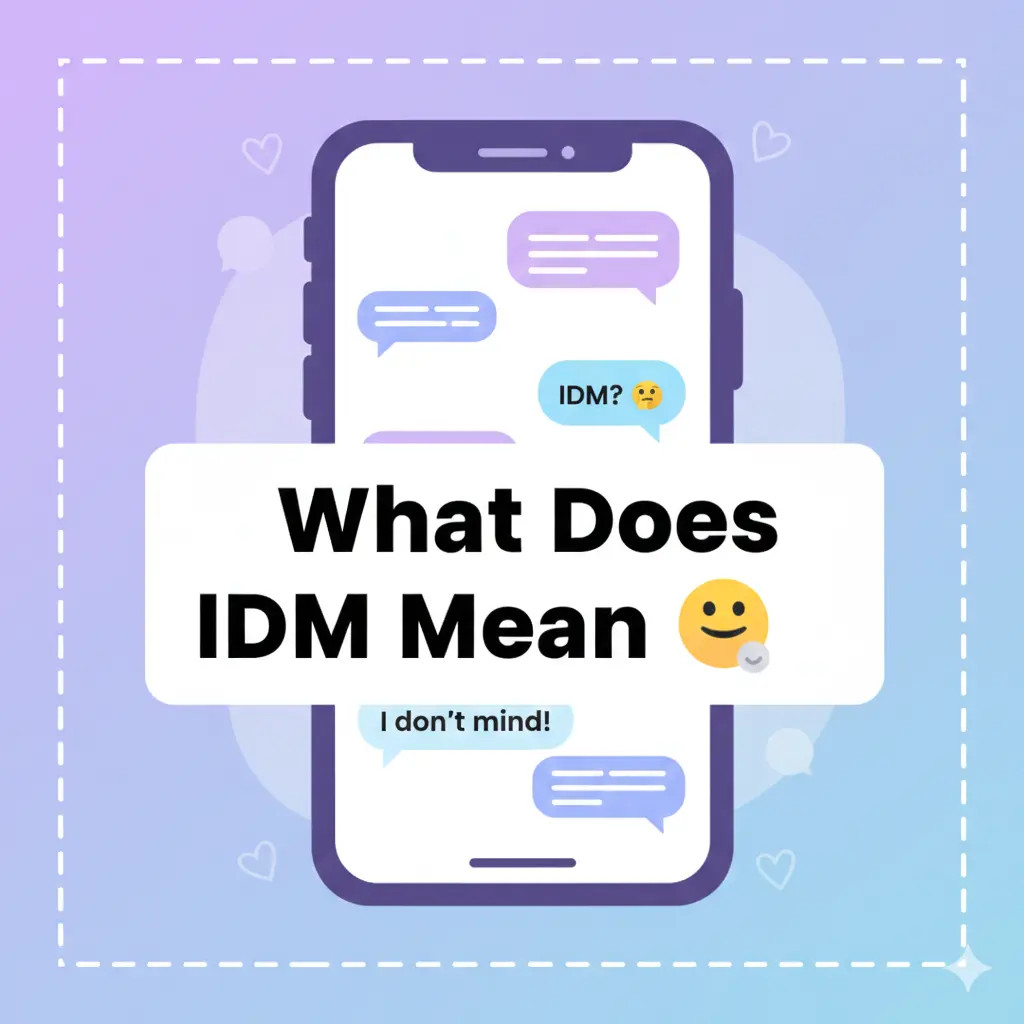
Have you ever been scrolling through your phone and suddenly saw someone type “IDM” in a chat and wondered, “Wait, what does IDM mean?”
I had the exact same moment last week when a friend sent me a message: “IDM if you come to the party 😅.” At first, I had no clue what she meant! If you’ve been searching online asking “what does IDM mean”, don’t worry—you’re not alone.
In this guide, we’ll break down exactly what IDM stands for, show how and when to use it in texting or social media, and even give you some real-life examples so you can confidently join the conversation.
Quick Answer:
In texting, IDM usually stands for “I Don’t Mind.” People use it to show they are okay with something, giving consent, or showing agreement in a casual conversation.
What Does IDM Mean in Text?
In text slang, IDM stands for “I Don’t Mind.” It’s a casual way of saying that you’re okay with something, that you don’t have a preference, or that you’re fine letting someone else decide.
For example:
- Someone asks, “Do you want pizza or burgers tonight?”
- You reply: “IDM 😄”
This simply means, “I don’t mind which one we get—you decide!”
Sometimes, IDM can also mean “I Don’t Mean” in certain contexts, though this is much less common. This variation usually pops up when someone wants to clarify that they didn’t intend something in a previous message.
In short: the primary meaning is all about being chill, flexible, and easygoing in conversations.
Where Is IDM Used?
IDM is mostly used in texting, online chats, and social media platforms. You’ll see it on:
- Snapchat – in casual snaps or replies
- Instagram DMs – especially among friends or followers
- TikTok comments – when users react to someone’s video
- Discord or gaming chats – where quick, informal responses are common
It’s especially popular among teens and young adults, but you might also see it from anyone who wants to keep a conversation light and casual. Unlike abbreviations like “LOL” or “BRB,” IDM isn’t necessarily tied to humor; it’s more about showing flexibility or neutrality in a discussion.
Examples of IDM in Conversation
Here are some realistic examples to see IDM in action:
- Friendly:
Alex: “Do you want to watch a movie or play some games?”
Sam: “IDM, you choose! 😎” - Flirty:
Jamie: “Should we go to that new café tomorrow?”
Taylor: “IDM… but I’ll follow your lead 😉” - Funny:
Casey: “Pineapple on pizza, yay or nay?”
Jordan: “IDM, I’ll try anything once 😂” - Casual:
Mia: “Wanna meet at 5 or 6?”
Noah: “IDM, whenever works for you” - Group chat:
Friend 1: “Where should we hang out tonight?”
Friend 2: “IDM, anywhere is fine with me” - Polite/Neutral:
Colleague: “Should I send the report now or later?”
You: “IDM, either works”
As you can see, IDM fits in naturally whenever someone wants to stay neutral or easygoing.
When to Use and When Not To Use IDM
When to use IDM:
- When someone asks for your preference, and you genuinely don’t mind.
- In casual, friendly, or informal chats.
- In group conversations where you want to give others the freedom to choose.
When NOT to use IDM:
- Professional or formal settings: For emails or business communication, it’s better to write full sentences like “I’m fine with either option.”
- Ambiguous situations: If the context is serious and your input matters, saying “IDM” might seem uninterested or careless.
- Texting strangers: Using IDM with someone you don’t know well could come off as detached.
Tip: If you’re ever unsure whether your tone is appropriate, pair IDM with an emoji or short phrase to show friendliness, like 😄, 😉, or “no problem!”
Similar Slang Words or Alternatives
If you like using IDM, there are other slang abbreviations you might find useful:
- TBH – “To Be Honest” (used to express your true opinion casually)
- IMO / IMHO – “In My Opinion / In My Humble Opinion”
- IDC – “I Don’t Care” (more neutral or blunt than IDM)
- BRB – “Be Right Back” (commonly used for quick chat breaks)
- NBD – “No Big Deal” (casual reassurance similar to IDM)
These can be handy to mix up your texting style while keeping your messages short and relatable.
FAQS:
What does IDM mean in texting?
IDM stands for “I Don’t Mind.” It’s used to indicate that you are okay with something or have no objection in a conversation.
Are there other meanings of IDM?
In texting, IDM almost always means “I Don’t Mind.” Outside texting, IDM can refer to other terms (like “Intelligent Dance Music”), but context matters.
What does IDM mean from a girl?
IDM generally carries the same meaning regardless of gender—it simply means “I don’t mind.” Any nuance comes from the context, tone, or emojis she uses.
Is IDM slang rude?
No! IDM is not rude. It’s casual, polite, and neutral. However, in serious conversations, it might seem a little too laid-back.
Can I use IDM in professional chats?
Not really. It’s best saved for informal communication. In work emails or professional Slack messages, stick to full sentences like “I’m fine with that” or “Either option works for me.”
Does IDM have any flirty meaning?
It can, depending on context. If paired with a winking emoji or teasing comment, IDM can subtly signal playfulness or flirtation.
Is IDM still popular in 2026?
Yes! While not as viral as “LOL” or “BRB,” IDM remains a steady favorite for casual texting, especially among younger users and social media communities.
Conclusion
So, the next time you see IDM in a chat or post, you’ll know exactly what it means: “I don’t mind.” It’s a simple, flexible way to show that you’re easygoing or neutral in a conversation. Just remember—use it in casual contexts, pair it with emojis for friendliness, and avoid using it in professional or formal settings. With these tips, you’ll never be confused by IDM again!

Anderson is a skilled content writer focused on explaining modern text slang and digital communication trends. He creates clear, friendly content that helps readers understand online language quickly and confidently.